
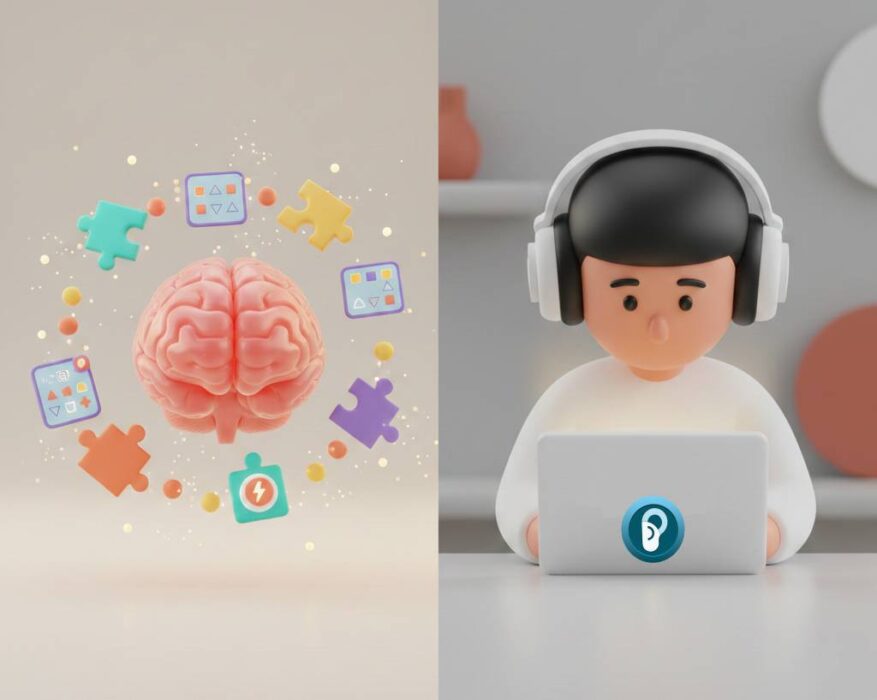
When it comes to brain training apps, Lumosity is often one of the first names people mention. With years of brand recognition and a wide library of cognitive games, it has become a major player in the space.
But newer platforms like Glisn are redefining what brain training can look like—especially for those who want to strengthen listening, focus, and real-world cognitive agility.
If you’re trying to decide which platform aligns best with your goals, here’s an objective breakdown of how the two compare.
Where Lumosity Excels
Lumosity has several clear strengths:
1. Established Brand & Research Framing
Lumosity has been around for over a decade and positions itself heavily around cognitive science. Its marketing leans into research-backed exercises designed to target memory, attention, speed, flexibility, and problem-solving.
For users who enjoy a gamified, arcade-style brain workout with measurable scores and progress dashboards, Lumosity delivers a polished experience.
2. Game Variety
Lumosity offers a wide variety of mini-games. These are typically short, visually engaging, and designed to feel fun and quick to complete.
If your goal is light, structured brain stimulation through visual puzzles and reaction-based games, Lumosity may feel familiar and satisfying.
3. Structured Training Programs
Lumosity creates daily training sets that rotate exercises automatically. For users who want a “just press start” routine without much customization, that simplicity can be appealing.
Where Glisn Takes a Different Path
While Lumosity focuses heavily on visual mini-games, Glisn approaches brain training from a listening-first perspective—and that distinction matters.
1. Listening as Cognitive Training
Glisn is built around active listening, working memory, and comprehension. Instead of tapping shapes or matching symbols, users process audio or video scenarios before responding to questions.
In real life, we don’t often solve abstract puzzles on a colorful screen. We process spoken information—in meetings, classrooms, conversations, and day-to-day decisions.
Glisn trains that exact skill.
2. Real-World Simulation Over Arcade Design
Lumosity’s exercises often feel like games (which is a strength for engagement).
Glisn’s exercises feel more like real-life scenarios.
With:
- Audio/video-led quiz prompts
- No skipping ahead while listening
- Free-text answers instead of multiple choice
- Quiz-first immersion modes
Glisn forces deeper cognitive engagement. You listen. You retain. You calculate. You respond.
There’s less guessing—and more thinking.
3. Mental Math & Verbal Processing Integration
One area where Glisn stands out is its crossover between listening and mental math.
Because questions can be delivered through audio or video and require typed responses, users strengthen:
- Auditory working memory
- Focus under time constraints
- Mental calculation without visual scaffolding
- Real-time comprehension
Lumosity offers memory and speed games, but Glisn trains cognition in a format closer to real-world performance.
Where Lumosity May Be Better for Some Users
To stay objective:
- If you want highly gamified, quick dopamine-hit exercises, Lumosity’s arcade-style approach may feel more immediately rewarding.
- If you prefer visual puzzles over audio-based processing, Lumosity may align better with your learning style.
- If you want a very structured, low-friction daily routine with minimal customization, Lumosity’s format is straightforward.
There’s nothing wrong with that. Different brains thrive on different formats.
Where Glisn Shines in the Final Analysis
Glisn isn’t trying to be an arcade brain game platform.
It’s training something deeper:
- Sustained attention
- Listening under cognitive load
- Verbal memory retention
- Real-time processing
- Mental math in spoken contexts
- Communication-based cognition
In a world where distractions are constant and conversations move quickly, the ability to truly listen and think on the fly is a competitive advantage.
Glisn doesn’t just test your brain.
It trains how you perform in real-world cognitive situations.
For students, professionals, lifelong learners—and anyone who wants sharper focus in actual conversations—Glisn offers a uniquely practical edge.
The Bottom Line
Lumosity is strong in gamified brain training.
Glisn is strong in real-world cognitive training.
If your goal is light, game-style stimulation, Lumosity may fit.
If your goal is sharper listening, stronger working memory, and improved mental math through real-time processing, Glisn delivers a more applied approach.
Ultimately, the best brain training tool is the one aligned with the skill you actually want to improve.
Ready to Train Your Brain for Real Life?
If you’re curious what listening-first brain training feels like, try a quiz inside Glisn today.
Put on your headphones.
Listen closely.
And see how your brain performs when it has to think in real time.