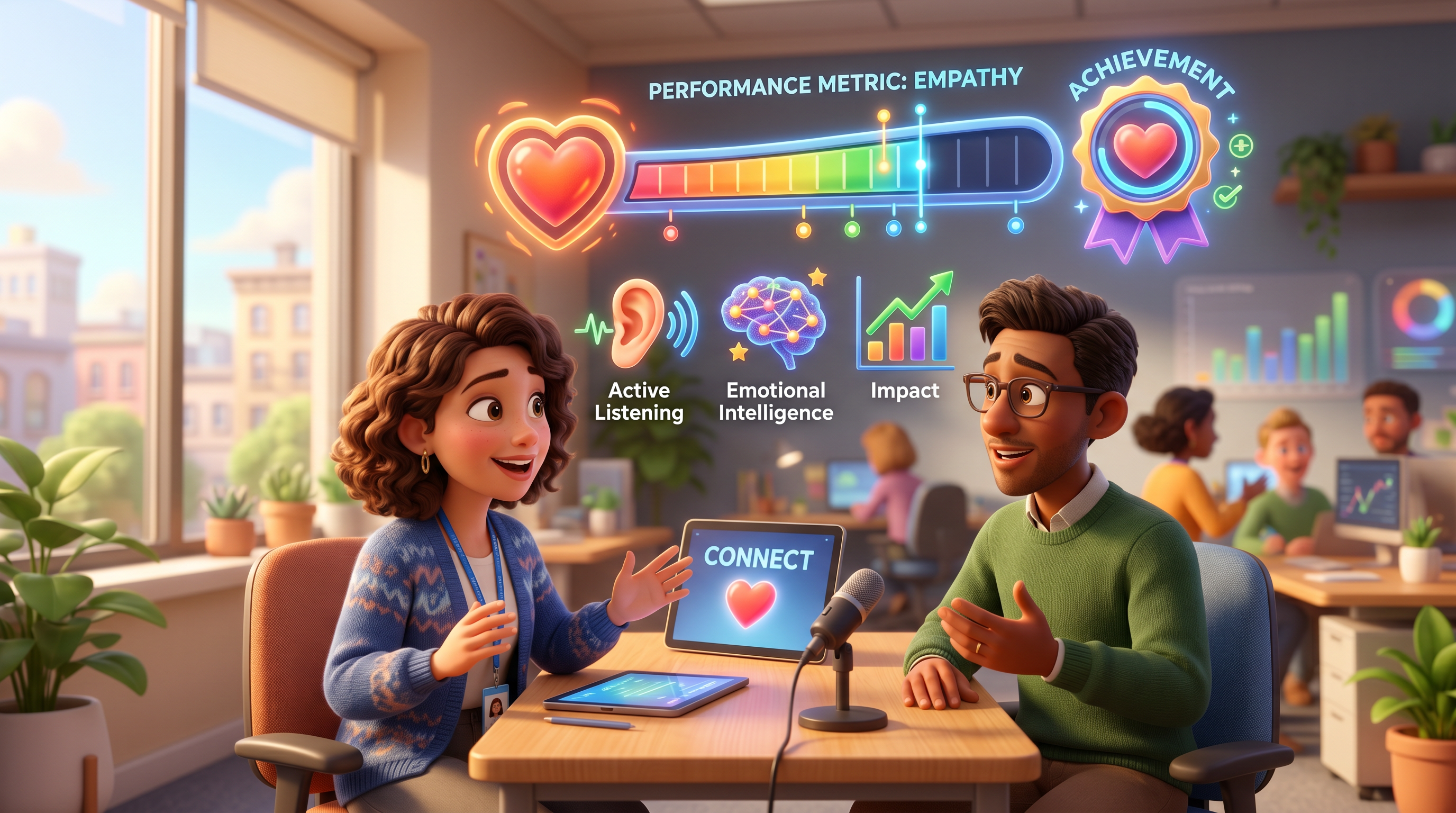
Why empathy isn’t just a soft skill: it’s a performance metric
Your manager just pulled last month’s numbers, and they’re not pretty. Your CSAT scores are down, call resolution times are up, and somehow you’re getting more escalations despite following every script to the letter. Sound familiar?
Here’s the thing most call centers get wrong: they treat empathy customer service like some touchy-feely bonus skill that’s “nice to have.” Meanwhile, the agents who naturally connect with customers are quietly crushing their metrics while everyone else struggles to understand why their perfect product knowledge isn’t translating to better performance.
Empathy isn’t soft. It’s strategic. And once you start tracking it like the performance driver it actually is, everything else starts falling into place.
The hidden connection between empathy and CSAT scores
Let’s cut straight to what matters: your numbers. When customers rate their experience, they’re not just evaluating whether you solved their problem. They’re rating how you made them feel during one of the most frustrating parts of their day—having to call customer service.
Think about your last five difficult calls. The ones where the customer was already heated before you even introduced yourself. Did the calls where you acknowledged their frustration upfront go smoother than the ones where you jumped straight into troubleshooting?
That’s not coincidence. When customers feel heard and understood, they’re 73% more likely to rate their experience positively, even when you can’t fully resolve their issue. That small shift in approach—leading with understanding instead of solutions—can be the difference between a 2-star and 4-star rating.
What this looks like in practice
Instead of: “I understand your frustration. Let me look into your account.”
Try: “That sounds incredibly frustrating, especially when you’re trying to [specific situation they mentioned]. No wonder you’re upset. Let me dig into this right now.”
The difference? Specificity. Generic empathy statements feel scripted because they are. Real empathy reflects back what you actually heard.
How empathy customer service drives call center performance metrics
Your performance review probably focuses on average handle time, first-call resolution, and customer satisfaction. What if I told you that improving your empathy skills could improve all three simultaneously?
When you start a call by genuinely understanding the customer’s emotional state, something interesting happens. Defensive customers relax. Angry customers start working with you instead of against you. And suddenly, calls that would have stretched 20 minutes with multiple transfers get resolved in 8 minutes with one conversation.
The empathy-efficiency paradox
It seems backward, right? Taking time to connect emotionally should slow you down. But here’s what actually happens:
- Customers explain their issues more clearly when they feel heard
- You spend less time managing their emotions and more time solving problems
- They’re more willing to try your suggested solutions
- You avoid the back-and-forth that happens when customers don’t trust your advice
One call center tracked this specifically: agents who scored highest on empathy assessments had 23% shorter average handle times and 31% fewer repeat calls on the same issue.
Building empathy skills that actually move your numbers
Forget the generic “I understand how you feel” training. Real empathy in customer service comes from developing specific, measurable skills you can practice and improve.
The 3-second emotional read
Within the first three seconds of a customer speaking, you can usually identify their primary emotional state. Are they frustrated? Confused? Worried about money? Embarrassed about not understanding something technical?
Your response changes everything. A confused customer needs patience and clear explanations. A worried customer needs reassurance and concrete next steps. A frustrated customer needs acknowledgment before they need solutions.
Reflective listening that builds trust
This isn’t about repeating back what customers say word-for-word. It’s about reflecting back what they mean, including the emotions behind their words.
Customer: “I’ve been trying to fix this for three days and nothing works. Your website is completely useless.”
Weak response: “I hear that you’ve been trying to fix this for three days.”
Strong response: “Three days of trying different solutions and still being stuck—that’s got to be exhausting. And when the resources that should help aren’t working, it makes the whole thing even more frustrating.”
The strong response shows you understand both the factual situation and the emotional impact. That’s the foundation for everything that comes next.
Measuring empathy like any other performance metric
If empathy drives results, you need to track it like any other skill. The best call centers are starting to include empathy-specific criteria in their quality assurance scorecards.
What to track
- Emotional acknowledgment: Did the agent recognize and respond to the customer’s emotional state?
- Specific reflection: Did they reflect back specific details, not generic empathy statements?
- Tone matching: Did their energy level and pace match what the situation called for?
- Solution framing: Did they present solutions in terms of customer impact, not just technical steps?
Teams that started scoring these elements saw average CSAT improvements of 18% within three months. More importantly, agents started seeing empathy as a concrete skill to develop, not some mysterious talent you either have or don’t.
The coaching conversation changes too
Instead of: “You need to be more empathetic with customers.”
Try: “In that call at the 2:30 mark, the customer mentioned feeling stupid about not understanding the instructions. That was a perfect opportunity to address the embarrassment specifically—something like ‘These instructions aren’t as clear as they should be’ before jumping into the solution.”
Specific, actionable, measurable. Just like any other performance coaching.
Making empathy your competitive advantage
Every call center trains product knowledge. Most train basic communication skills. But very few systematically develop the kind of emotional intelligence that turns routine customer service into memorable customer experiences.
That’s your opportunity. While your colleagues are focusing solely on technical accuracy and speed, you can master the skill that actually drives customer loyalty: making people feel genuinely understood and cared for.
The agents who figure this out don’t just hit their metrics—they consistently exceed them. They get promoted faster. They handle the complex escalations that others avoid. They build the kind of professional reputation that opens doors.
And it starts with recognizing that empathy isn’t about being nice. It’s about being effective.
Your next steps
Start small. Pick one empathy skill to focus on this week. Maybe it’s the 3-second emotional read, or getting more specific with your reflective listening. Track it alongside your other metrics and watch how the numbers connect.
Your customers are already telling you how they feel—in their tone, their word choices, their pace of speech. The question is whether you’re listening strategically enough to use that information to drive better outcomes for everyone involved.
Ready to develop the active listening and empathy skills that actually move your performance metrics? Glisn helps customer service professionals practice these exact scenarios with real call center audio and targeted feedback. Try it free and see how quickly better listening translates to better numbers.
