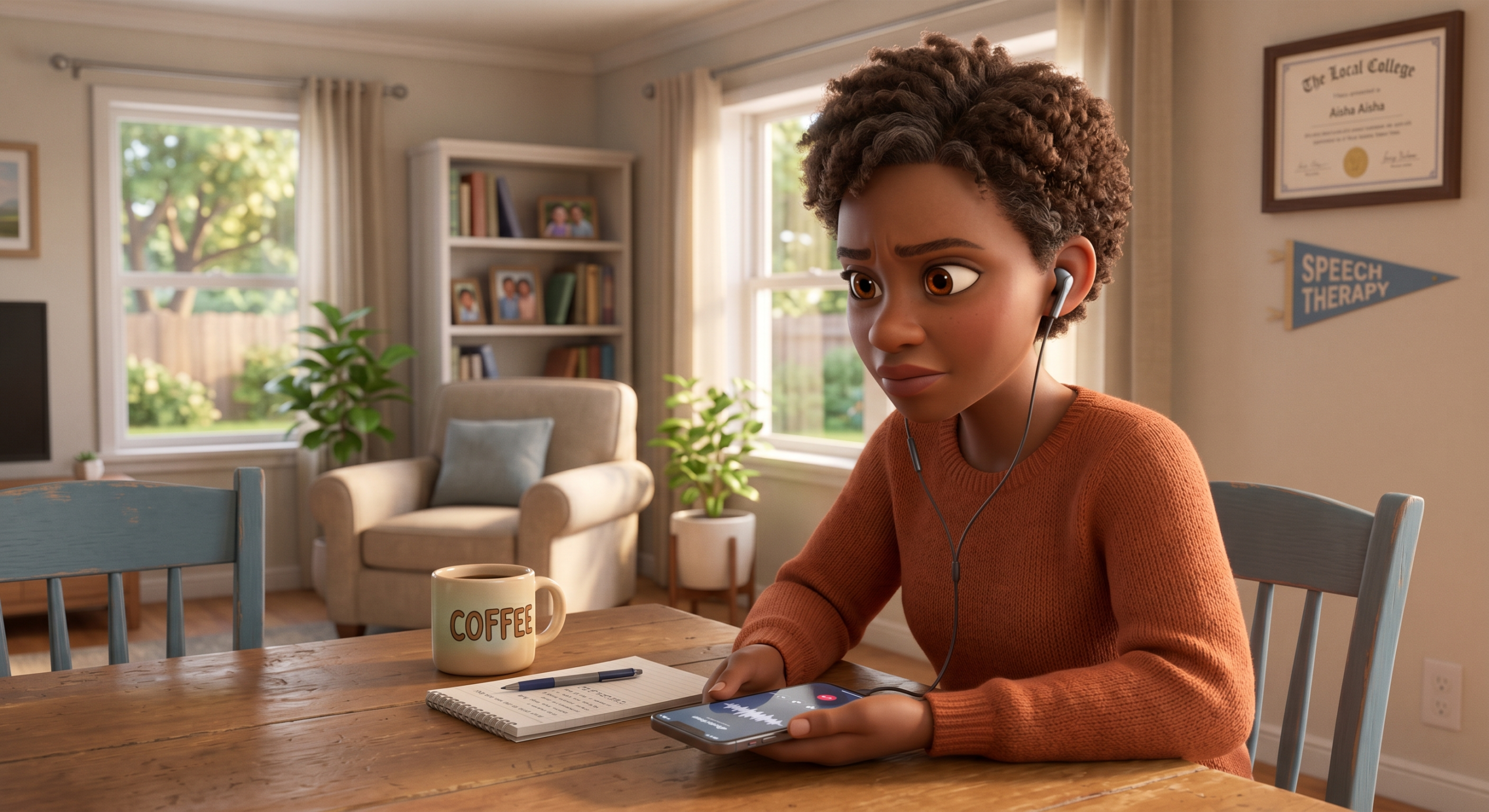
Every SLP with an adult caseload knows this moment. A client demonstrates clear progress on an auditory comprehension task inside the session — follows a contextually loaded passage, tracks a multi-step instruction, answers inference questions with accuracy that wasn’t there three weeks ago. You’re genuinely encouraged. Then Thursday comes, and the same task requires nearly as much scaffolding as it did at the start.
The clinical term is generalization failure. The practical reality is simpler: auditory comprehension depends on volume of practice, and clinical schedules can’t provide enough of it. This post is about that structural gap — what the research says about between-session practice, what most home practice tools fail to provide, and where a consumer listening app called Glisn fits into the picture without overpromising.
Key Takeaways
- Auditory comprehension gains in aphasia rehabilitation required >9 hrs/week over 3–4 days to produce measurable results — yet most outpatient services deliver ~60–90 minutes/week (RELEASE Study, Stroke/AHA, 2022)
- 64.9% of adults enrolled in home-based auditory training programs stopped after 10 or fewer sessions — a compliance ceiling that worksheets and encouragement alone haven’t moved (Frontiers in Human Neuroscience, 2024)
- Each additional day of self-managed digital practice per week, up to 4 days, produced measurable incremental language gains in a 2,249-participant post-stroke cohort (JMIR, 2022)
The Gap Between the Session and the Week
The problem isn’t effort. It’s dosage. Auditory comprehension recovers through repetition, and the frequency and volume of practice that produces measurable gains is well outside what clinical schedules can deliver.
A 2022 individual participant data meta-analysis published in Stroke — the RELEASE Study, drawing on 959 participants across 25 trials — found that evidence of auditory comprehension gains was absent for therapy delivered at fewer than three hours per week, fewer than three days per week, or fewer than 20 total hours of treatment. The threshold associated with peak comprehension gains was more than nine hours per week over three to four days (Brady et al., Stroke, 2022). Most outpatient speech-language services deliver somewhere between 60 and 90 minutes weekly. That gap doesn’t close on its own.
Weekly Practice Delivery vs. Evidence Thresholds for Auditory Comprehension Gains
Hours per week — clinical delivery vs. dosage thresholds from individual participant data meta-analysis
| Typical outpatient SLT |
|
~1.25 hrs/wk |
|---|---|---|
| Minimum threshold for any gains |
|
>3 hrs/wk, 3+ days |
| Threshold for peak comprehension gains |
|
>9 hrs/wk, 3–4 days |
The same RELEASE analysis found that prescribed home practice alongside clinical SLT was associated with a 5.28-point improvement on the Token Test — a standardized auditory comprehension measure — compared to sessions alone. The gains attributable to structured between-session practice aren’t anecdotal. They’re documented, quantifiable, and consistent with what SLPs observe when clients actually do the work between visits.
What’s available to fill that gap? Home practice worksheets are passive in a way that listening comprehension training fundamentally isn’t — you can’t build comprehension by reading. Most adult language apps address word retrieval or articulation. The apps built around auditory comprehension work tend to be designed for supervised clinical environments, pediatric populations, or both. And the fast, dense, contextually loaded speech that clients encounter in daily life is largely absent from any of them.
This isn’t a motivation problem. A 2024 systematic review in Frontiers in Human Neuroscience — screening more than 1,600 records across 13 studies — found that 64.9% of adults enrolled in home-based auditory training programs completed 10 or fewer sessions before stopping (Frontiers in Human Neuroscience, 2024). That dropout rate reflects a tool problem more than a willpower problem. When available materials don’t match the actual practice need, they don’t get used.
What Auditory Comprehension Practice Actually Requires

There’s a meaningful distinction between passive exposure to language and active engagement with meaning. They’re not the same cognitive exercise, and they don’t produce the same outcomes. What does effective between-session listening comprehension practice actually look like?
The properties that appear consistently across the literature are these: effective material is narrative — it involves characters, sequence, causality, and inference, not isolated words or decontextualized sentences. The listener must hold developing information in working memory, integrate it against prior context, and build a real-time model of what’s being communicated. That is what real-world listening demands. It’s also what most available home practice materials don’t replicate.
Immediate comprehension accountability matters at least as much as the listening task itself. Questions that follow an audio passage and can’t be skipped or revisited close the feedback loop that passive listening leaves open. The client learns exactly where retention held and where it didn’t. That’s the signal that drives directed improvement. Without it, practice accumulates repetitions without direction — the client has no way to know whether they’re actually getting better.
There’s a clinical literature on accelerated long-term forgetting (ALF) in patients with acquired brain injury that rarely gets applied to the SLP home practice question, and it probably should. Research published in Brain Injury in 2024 documents what experienced clinicians often observe: patients with acquired brain injury can show normal or near-normal retention on standard assessments immediately after learning, yet lose newly acquired material significantly faster than expected over the following days and weeks (Taylor & Francis, Brain Injury, 2024). A client who consolidates a skill well on Monday may not retain it by Thursday — through a mechanism that has nothing to do with effort or motivation, and that looks, from the outside, like noncompliance. The between-session window isn’t neutral. It’s a decay window, and its length matters.
A 2022 retrospective cohort study tracking 2,249 post-stroke survivors in self-managed digital speech therapy found that practicing three to five days per week produced significantly greater improvement than practicing one day per week across all language and cognitive domains. Each additional day of practice, up to four days, was associated with measurable incremental gains — a frequency-response relationship that holds consistently across the digital rehabilitation literature (Haley et al., JMIR, 2022).
Practice Frequency vs. Language Improvement in Digital Post-Stroke Rehabilitation
Retrospective cohort — 2,249 post-stroke survivors using self-managed digital speech therapy (JMIR, 2022)
| 1 day/wk | 2 days/wk | 3 days/wk | 4–5 days/wk |
|---|---|---|---|
|
|
|
|
|
| baseline | significant gain | greater gain | greatest gain |
The practical question for the SLP isn’t whether between-session practice matters — the evidence on that is consistent. The question is whether the tools available for that practice match the cognitive demands that auditory comprehension training actually places on the listener.
A Listening Comprehension Tool That Fits a Specific Gap
Consider a practice format built like this: the listener hears a short, recorded audio scenario — a workplace conversation, a phone call, a social exchange — at natural speaking pace, in real time. There’s no rewind. When the scenario ends, comprehension questions follow immediately. Some test specific content; others test inference. Most adults miss at least a few. Even adults with strong baseline language function find the combination of pace, density, and no-repeat accountability more demanding than they expected.
That’s Glisn. It’s a consumer listening app built around short, adult-oriented, real-life audio scenarios followed immediately by comprehension and retention questions.
What it isn’t requires saying clearly, because this audience’s credibility — and ours — depends on precision here. Glisn is not a clinical assessment tool. It doesn’t generate standardized scores, interface with clinical records, or require SLP involvement to function. It isn’t designed for any specific diagnosis. It hasn’t been validated in clinical trials for any condition or population. It isn’t a replacement for the therapeutic relationship or for the clinical reasoning that determines treatment targets.

What it does offer is a practice format that addresses the gap described above. Adult clients who benefit from regular, structured listening practice — and who would otherwise do none between sessions — have a tool that meets them at the level of real-world communication complexity. The scenarios aren’t simulations of clinical exercises. They’re simulations of the kind of listening that actually happens in daily life: fast, dense, contextually loaded, with no opportunity to ask for repetition or clarification.
For SLPs working with adults who benefit from increased practice volume — whether recovering from stroke or TBI, managing APD, or working on attention-related listening difficulties — the clinical question isn’t whether Glisn addresses those conditions. It doesn’t, and it makes no claim to. The question is whether a client doing structured listening practice four days a week is better positioned than a client doing none. The frequency data from the digital rehabilitation literature suggests they are.
Puzzles train you for puzzles. Glisn trains you for life.
Before You Think About Your Clients, Try It Yourself
The most reliable way to evaluate whether something has a place in your clients’ routines is to experience it as a listener yourself — before forming any clinical opinion about it.
A scenario you might encounter: a 90-second workplace conversation between a manager and a direct report. Feedback is delivered, context is implied, a timeline is established, and several things are left unstated. Twelve comprehension questions follow. Most clinically trained listeners — people who work with language professionally — miss at least three. The questions aren’t obscure. They test the kind of retention that everyday communication demands, and that most adults assume they’re doing well on until they see the results.
If you find it easy, that’s worth knowing. If you find it harder than expected — that’s also worth knowing. Either way, it tells you something about the experience your clients are likely to have with it.
Download the app and try a scenario at glisn.net. It’s free to start. No form, no demo request, no sales contact.
If you’re curious about how this might fit for specific clients, or want to talk through appropriate use cases, you’re welcome to reach out directly: info@glisn.net.
Frequently Asked Questions
What types of adult clients might benefit from a structured home listening practice app?
Adults who tend to benefit from between-session listening practice include those recovering from stroke or TBI, adults with APD or attention-related listening difficulties, and older adults managing age-related changes in auditory processing. The common thread isn’t diagnosis — it’s that the client benefits from more structured listening practice than sessions alone provide and is capable of independent use. Whether Glisn fits a given client is a clinical judgment that rests with the SLP.
Is Glisn an evidence-based auditory comprehension app for adults?
Glisn hasn’t been studied in clinical trials for any specific diagnosis or outcome. It’s a consumer listening app built around real-life audio scenarios and comprehension questions — not a treatment platform, and it doesn’t claim to be one. The broader research on home practice frequency and dosage in digital rehabilitation is consistent and peer-reviewed; Glisn is one tool that fits the practice-volume rationale, but clinical suitability is determined by the SLP’s judgment about each client.
Why do most adult speech therapy clients stop completing home practice programs?
A 2024 ASHA Perspectives study found that 88% of families reported psychosocial barriers to completing speech home exercise programs (ASHA Perspectives, 2024). Beyond motivation, there’s a tool problem: most available materials don’t match the cognitive demands of real-world listening, don’t provide feedback on where comprehension broke down, and don’t feel relevant enough to daily life to sustain engagement. Tools built around everyday communication — rather than clinical task replications — tend to have better adherence profiles.
How much home practice frequency is needed to see results in auditory comprehension rehabilitation?
The RELEASE Study (2022) established that auditory comprehension gains were absent below 3 hours/week or 3 days/week, peaking at more than 9 hours/week over 3–4 days. The JMIR retrospective cohort (2022, n=2,249) confirmed that each additional day per week of self-managed digital practice, up to four days, produced measurable incremental gains. A client practicing four days a week — even in short sessions — is practicing at a frequency the literature associates with meaningful outcomes.
